Rug Guides
How to Tell If a Moroccan Rug Is Authentic: 8 Simple Checks
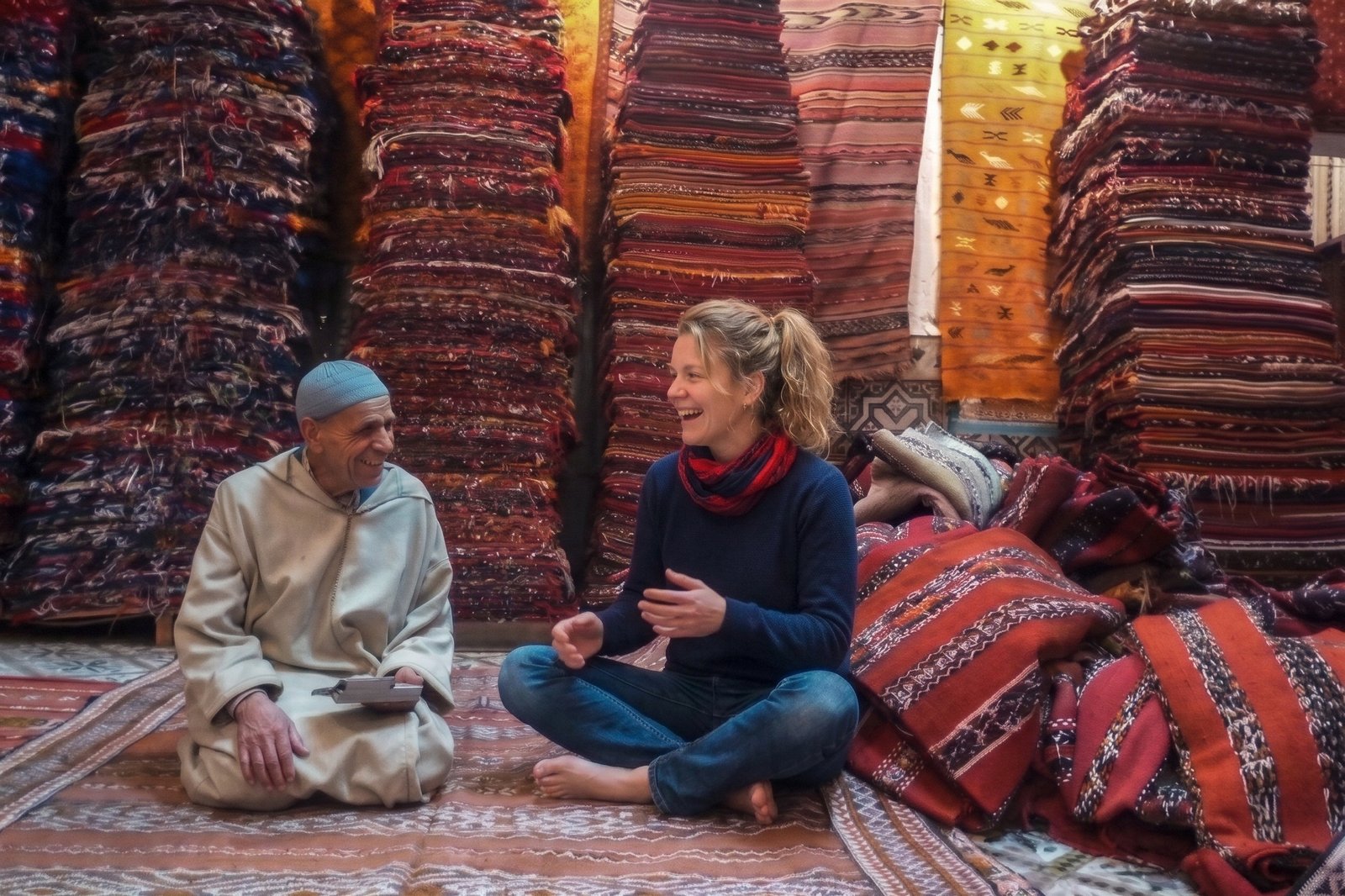
“Moroccan-style” rugs are everywhere — in big-box stores, on marketplaces and on social media. Many of them are machine-made, tufted or made of synthetic fibres. The good news: with a few simple checks, anyone can tell an authentic Moroccan rug from a machine-made copy.
What makes an authentic Moroccan rug?
An authentic Moroccan rug is made by hand in Morocco, almost always by Amazigh (Berber) women, using wool or recycled textiles, on a loom. It can be hand-knotted (with a pile) or flat-woven (without one) — both are authentic.
Be careful with words like “Berber-style”, “Moroccan-inspired” or “Beni Ourain look”: they describe an appearance, not an origin. A rug can look Moroccan and still be machine-made in a factory on another continent.
8 checks to recognise an authentic Moroccan rug
1. Turn it over and look at the back
On a handmade rug, the pattern is clearly visible on the back, with small knots or woven rows you can see and feel. A machine-made or tufted rug usually has a glued fabric or latex backing that hides how it was made.
2. Check the fringe
On a real rug, the fringe is the continuation of the warp threads that ran through the loom. Gently pull it: it should be part of the rug. On copies, the fringe is often sewn or glued on afterwards.
3. Look at the edges
The sides (selvedges) of a handmade rug are finished by hand and show small irregularities. Perfectly straight, machine-stitched edges are a warning sign.
4. Look for imperfections
Slight differences in width, pile height, colour or symmetry are signs of handwork, not defects. A perfectly regular rug with a repeated, identical pattern is very likely machine-made.
5. Feel the wool
Moroccan wool feels warm, soft and slightly waxy thanks to its natural lanolin. Synthetic fibres feel slippery, cold or plasticky. If the seller allows it, a burn test on a single loose fibre is telling: wool chars and smells like burnt hair, while synthetics melt and smell of plastic.
6. Check the colours
Hand-dyed wool shows subtle variations in tone across the rug. Completely flat, uniform colour suggests industrial yarn. To check that colours won’t bleed, press a damp white tissue on a coloured area: it should stay clean.
7. Ask about the origin
A trustworthy seller can tell you where the rug was made, by which community or cooperative, with which technique and which materials. Vague answers such as “from the Atlas” with nothing more are not enough.
8. Think about the price
Weaving a medium-sized rug by hand takes weeks of work, after the wool has been washed, carded and spun. A very large “handmade” rug at the price of a factory rug should make you suspicious.
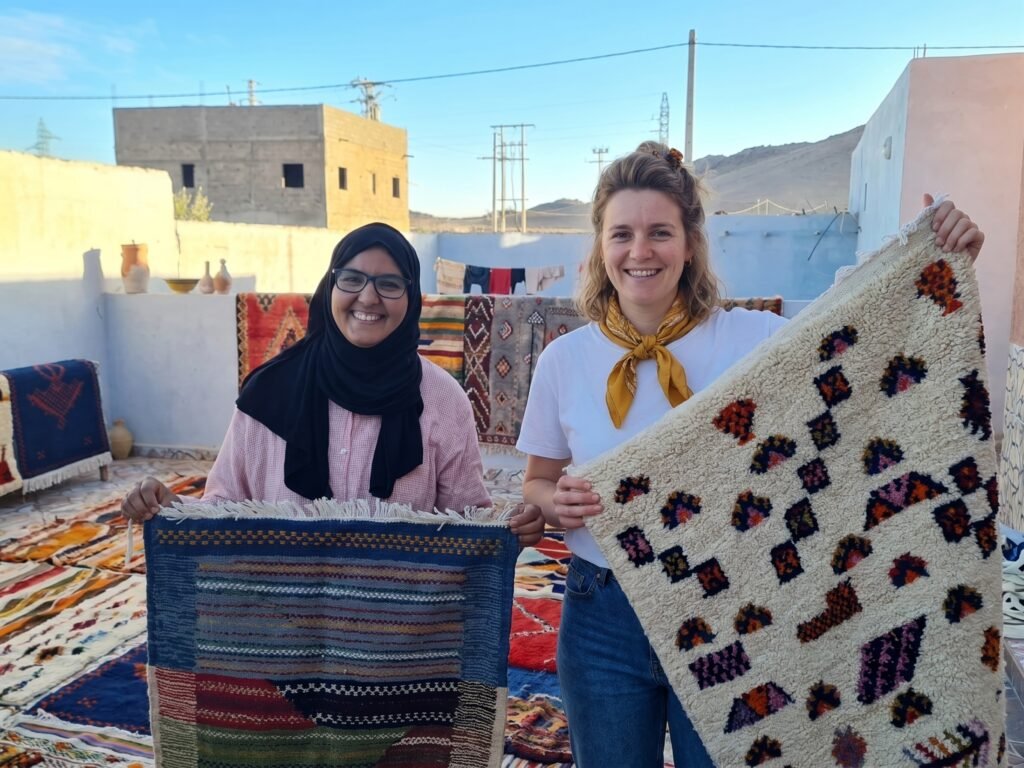
Red flags when buying online
- Only one photo, or photos that look like stock images used by many shops.
- No photo of the back, the fringe or the edges — and no answer when you ask for one.
- Materials listed as polyester, viscose, “art silk” or simply “soft fibre”.
- The same “unique” rug available in many sizes and quantities.
- No information about where or how the rug was made.
How we make it simple at MarrakechTribe
Every one of our handmade Moroccan rugs is handmade in Morocco by women’s cooperatives. On each product page, we tell you:
- where the rug was made and by whom (for example, our Akhnif rug comes from a women’s cooperative in Taznakht);
- the technique (hand-knotted or flat-woven) and the material;
- the exact size and weight.
Want to see the back or the fringe before buying? Just ask us. And if the rug isn’t what you expected, you have 14 days to return it — see our Shipping & Returns page.
Frequently asked questions
Are all Moroccan rugs hand-knotted?
No. Many authentic Moroccan rugs are flat-woven (like kilims and Zanafi rugs) or made from recycled fabric (Boucherouite). Handmade is what matters, not the technique.
Is “Berber rug” a guarantee of authenticity?
No. “Berber” describes the people and the tradition, and the word is widely used for machine-made copies. Always ask where and how the rug was made.
Are irregularities a defect?
No — small irregularities in shape, size and pattern are the signature of handwork.
Can an authentic Moroccan rug be cheap?
Small or simple pieces can be affordable, but a large rug represents weeks of skilled work. A price that seems too good to be true usually is.
Next, discover the different styles in our guide to Moroccan rug styles.
Keep reading
More from the Journal
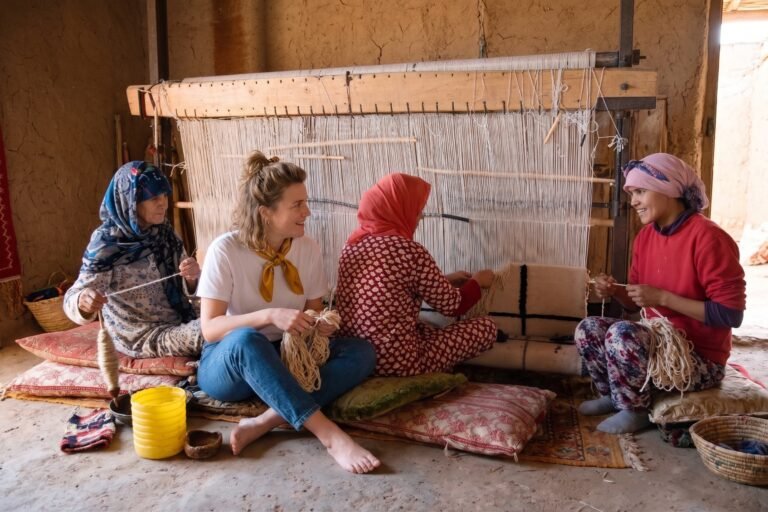
Taznakht Rugs & the Women Who Weave Them
In the mountains of southern Morocco, Amazigh women have woven rugs for generations. Discover how a Taznakht rug is made, what makes…
Read the article
Types of Moroccan Rugs: A Guide to Beni Ourain, Azilal, Boucherouite, Taznakht & More
Beni Ourain, Azilal, Boucherouite, Taznakht, Zanafi, kilim… A clear guide to the main types of Moroccan rugs, where they come from and…
Read the article
What Size Rug Do You Need? A Room-by-Room Guide (+ How Delivery Works)
Living room, bedroom, dining room or hallway: simple rules to choose the right rug size — plus what to expect when your…
Read the article